Wednesday, July 22, 2009

second thoughts

In a burst of creative thought over the last few days I scoured the pages of my architectural books and magazines (in several languages) as well as the Internet looking for anything that would help me put together a second generation house for my family, as that possibility has been simmering in the back of my mind since returning from our last vacation recently. It started with a trestle-frame addition to stick-frame building, progressed to a long building with a floorplan reminiscent of a mobile home or ATCO structure, and later incorporated a "ryokan" and numerous storage and space saving ideas. At this point it seemed over engineered and I rejected it all, asking myself "Did I lose sight of what's important?" (Double meaning fully implied, as I had been neglecting other responsibilities in pursuit of an ideal house design.) I took the contrary position, feeling that a trestle-frame, like a geodesic dome, should not be a house, as its form is not plastic enough and too rigid. I looked at the other-beauty of rammed earth. Then I reviewed photographs of real trestle-frame buildings, and loved this one of a barn. In America, there was a vogue about a decade ago of restoring old American timber frame barns and converting the interiors into houses. The cathedral ceilings and exposed ancient timbers created a warm (insert adjective evoking fondness of aged things) ambiance that afficionados of the type loved. They didn't substantially change anything about the barn's dimensions. I can learn a lesson from this comparison, as I won't change the dimensions or proportions of this Norwegian barn. I will simply fit the modern American lifestyle within its timbers.

Update: I'd like to build alcove beds, as used in roykstova (traditional Faroese houses), into the sides of a trestle frame shed of about these dimensions.

Friday, July 17, 2009

Birthday: an existential occasion

As I recently passed the anniversary of my birth, I reflected on the current “state of my body”. I also thought about Stephen Covey and existentialism, because of that chapter title of his, “begin with the end in mind”. I want to take better care of my body, beginning with eating and sleeping. Eating staples like grains, legumes, tubers, and healthy food combinations. (Recently I had a great meal, baked salmon marinated in soy sauce and rice wine, with an unusual coleslaw side composed of kohlrabi, radishes, carrots, napa cabbage, and cilantro, in a primarily vinegar dressing. I ate more of the slaw than the salmon! Delicioso!) In a period of two months I want to update my professional counseling certification, construct a log trestle frame building, and progress in my correspondence class. In a year I want to have some conversational Japanese skills, a four year degree from the university, and apply to teach English in Japan. Eventually I might like to build a house in Homer (or Hokkaido?), that incorporates Norwegian log trestle frame construction in at least one wing of the house, and live near the ocean teaching one language or the other in either country. Commuting to work and back by electric bike would be a bonus. And if I learn a second language, perhaps learning to play a musical instrument like the guitar wouldn't be too far a stretch. My life right now is great, but how much more could it still be? Right now, this is a partial vision of one end I have in mind, and the elusive elements of which it is composed that have yet to fall into position.

Sunday, July 5, 2009

Brave New World

Probably the best way to get inside the head of another person is to expose yourself to the products of their self expression - stuff like literature, art, and music. This is very effective. Transhumanists might make the following prediction however, that what the Internet has been to personal computing, a computer brain interface allowing technologically enabled telepathy (group mind) would be to the human mind and individual perspective. Very interesting implications can be drawn from such a possibility, but I will stick with literature, art, and music for the time being when I want to see the world through another person's eyes.

Monday, June 29, 2009

lawnmowers and dragonflies

This morning I was reading about a truck that uses gasification technology, and it lead me to thinking about lawnmowers. I need to sharpen my non-motorized push lawnmower or buy one with an engine. I remember reading about Harry Schoell, the inventor of the heat regenerative cyclone engine and their prototype lawnmowers developed as a possible application for the technology (supposedly ready by 2010). That would be fun to have! But then again, if had a lawnmower that used gasification technology, perhaps the grass clippings could be used as the fuel, which would make the lawnmower nearly autonomous, much like a solar powered artificially intelligent lawnmower. If AI beings ever take over the world, my money says it starts with lawnmowers (or a swarm of Roomba vacuum cleaners).

This afternoon I was outside standing and talking with my clients when a dragonfly flew up to me and landed on my left temple. I thought that was just too cool, never happened to me before. I continued giving my speech and let the insect rest on my head. I could just barely see it with my peripheral vision, and feel its light weight on my skin. Think of it as a counter-example to H.P. Lovecraft's cosmic indifferentism if you want.

I haven't the time to read it now, but if you do, tell me what you think of this article about the research of George Vaillant titled "What makes us happy?"

Wednesday, June 24, 2009

common sense

I found this picture in my chainsaw manual under the heading "Always use common sense".

Thursday, June 18, 2009

Optibike


Paraphrased from the website: "The 2000 mpg human-electric hybrid vehicle augments the rider's pedal power with an electric motor and battery traveling 50 miles on $.08 worth of electricity at 30+ mph." Okay, now that I got all the hype out of the way, this is really a very cool bike. It's not a moped, so no loud smelly engine stuff. It's not a recumbent, but it is so cool that I forgive that one design flaw (could be fixed). Electric assist bikes just don't get the attention they deserve. I want. See also the Optibike Owner's group. (This or even this is much more within the realm of the possible for me however.)

Saturday, June 6, 2009

Modern direct-drive recumbent bikes

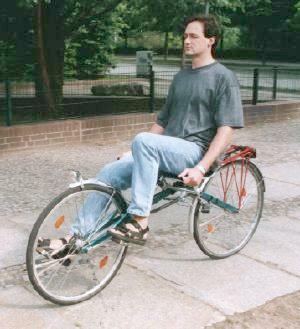
When a friend of mine told me he was thinking about buying a new recumbent bike, I began surveying the choices available on the market to help him find the right one to meet his needs. Human powered transportation is a subject close to my heart. In the process of reviewing the incredible variation of bikes, I came upon the "direct drive" recumbent bike design that appeals to me (my motivation to help was not purely altruistic). A direct drive bike has the crank axle mounted on the front fork, inside the hub of the driven front wheel; no chain is needed. This front hub also houses a transmission system to allow a wide range of gears for slow or fast speeds.

The direct drive approach, though not commonly seen on bikes today, actually preceded the use of the chain drive, but was overshadowed by it as bicycle designs evolved due to the primitive stage of technical developent of hub gears at the time. The design of the transmission is probably the most complicated part of the whole bike, but today it is no longer a limitation. Planetary gear hub, Schlumpf Speed-Drive, Rohloff 14-speed hub, Sachs "Elan" 12-speed hub, and Biria continuously variable transmission hub: these are some reliable hubs that may be adapted to use in a direct-drive bike, with modification. The overall appearance of a direct drive bike is very clean and simple, and the compact drive system dramatically improves cargo carrying capacity. Though not yet available, were such a bike to enter the market, and if it were designed as carefully as Garnet recommended in his paper, I am sure it would be well received, especially by myself!

One disadvantage of this design is the width of the tread, more commonly known as the q-factor. This is the distance between the pedals that the rider's feet must straddle. Since the geared hub must be within this space, the q-factor cannot practially be reduced beyond the limits imposed by current technological ability to create a small geared hub.

References:
Kretschmer, Thomas (2000). "Direct-drive (chainless) recumbent bicycles.", Human Power, no. 49:11-14.
Garnet, Jeremy (2008). "Ergonomics of direct-drive recumbent bicycles.", Human Power eJournal, article 17, issue 05.
Photo of Kretschmer's bike
Another bike built by Stefan Daniel