I am of average physical fitness, maybe a little above, but not much. Nine months out of the year I run/ski/bike about 4 miles a week (two miles, two days) in a three months on, one month off, repeating schedule that coincides with my work schedule. After the end of a three month period of exercise I am at my best, and I am at my worst following the one month of no exercise. May was the no exercise month. My only training strategy was to get eight hours of sleep the night before. So there's one strike against me.
June saw a sweep of illnesses in my family, last hit was me, and I am still recovering. I have a normal 40 hour work week, but also two little kids and hence less than optimal sleep at night. Strike two (and three?).
But I was looking forward to the 10K Midnight Sun Run yesterday. Last year I did a one mile road race, so this was the next logical step, right? Mostly, this was a fun opportunity that I didn't want to miss. I guess about 3500 other people felt the same way. I had a few goals I set for myself: avoid injury and beat two of my friends, who were also in the race.
It is too bad they didn't offer split times for each mile, that would really tell the story of my race performance the best, but I can provide the details myself. The start seemed chaotic - a hoard of people gathered on the road, then seemingly without warning a shot went off and we surged forward. I said good bye to my friend and trailed another person as we passed people by. Eventually I stopped passing people and they started passing me. A man stood at the first mile mark reading off the time. Seven minutes 15 seconds as I passed him. Not much later I began to wonder if I could last the remaining five point two miles. My stride shortened and I just kept determinedly throwing one foot ahead of the other. In the back of my mind was the most recent running advice I had read. Halfway through the race my right leg was getting sore. Then by mile five the pain was too much too ignore and I knew I had to walk. "You don't have to win, you just have to finish." I heard people say on the sidelines. The spectators were great, offering water, water hoses to cool you down, music to pump you up. Some of them looked a little smug and lazy. Here I was running my legs off and all they did is sit back and watch, it seemed a little unfair. When I began to walk I knew my time would really suffer for it, but better my time than my body. It was an interesting experience actually. I remember seeing runners crawl across the finish line in pain in some of the televised marathons. Would that happen to me? A few people asked if I was okay, I assured them I was. Once I got to the last fraction of a mile I again tried to run. My calves immediately cramped up. No striding allowed. Taking a cue from a runner ahead of me I began to run in short quick steps, as if I were pogoing to the finish. My last glance at the clock on the finish line showed just under an hour and two minutes. I wanted to get under an hour, but I'll take it. Past the finish line a few tables were piled with sliced oranges and watermelon - the sweet taste of success. I grabbed a juicy slice of orange and spotted one of my friends. To our mutual surprise he beat my time (we saw each other when he passed me as I walked). I got some ice on my leg from a sportsmedicine table at the finish line, caught a bus back to the start where I parked my car, picked up a few groceries, then went home.
After the finish, despite the pain in my leg, I felt good. And most of that was simply because I did it, last year I didn't. That day of the race started early for me, I took my daughter to the clinic to have her ear examined; went to a downtown Summer Solstice festival and ate cheesesteak sandwiches and berry smoothies; did a little shopping. I also visited friends who recently had their first child and met their boy for the first time. On Monday they are packing up to leave town for a new job location so it was a good bye too.
You have to be healthy to run, but you don't have to run to be healthy. While at the race I met a guy who ran it in about 44 minutes. He loved running. I am not sure I love running as much. There was a time when I did, and maybe that time has passed. Or maybe I just need to train more beforehand. My official time was 1:01:52.5, I know I can beat that next year. Either way, a 10K is the most I ever plan to run!
Monday, June 23, 2008

Sunday, June 22, 2008
huskies
The Alaskan Husky is not a standardized breed, but a dog more defined by its purpose than any physical trait. Here is a picture of two adult huskies that really show the variation in size. On the left is Kavik, a 14 year old male husky owned by a friend, and on the right is Maxine, my about two year old female husky. Kavik is clearly much much bigger than Maxine, his pedigree may include larger breeds like the Alaskan Malamute, and likwise Maxine's pedigree most likely has the influence of a smaller breed.

Thursday, June 19, 2008
wildlife around the house
I think it was about a week ago, on 11 June, that I saw a nice female jumping spider near my house on a pipe leading to the rainwater tank. Since then I have seen a smaller male in the same area. It was last summer that I recognized the first jumping spider I ever saw, Sitticus finschi, but these spiders I've seen this year are a different species with some different markings. The female has two rows of three yellow/white dots on the back of her abdomen, the male's pattern was less noticable overall but both have an attractive mottled grey background. As with all jumping spiders, watching them move about is a lot of fun. I was thinking dressing up as a jumping spider for the upcoming 10K Midnight Sun Run would be a good costume. Or maybe attach some big fake spiders on my clothing and declare that I am the infamous comic superhero. Now, where did I put my toy spiders?
There are a lot of other neat animals around. I've seen a great grey owl silently flying through the forest, a red fox, voles, wolf spiders and web-building spiders, fiery searcher beetle (genus Calosoma), and carpenter ants looking for a new nest site. This year has seen a bumper crop of Whitespotted sawyer beetles (Monochamus scutellatus) in the area. They are easily recognized by their big size, with white spots on a black body and long antennae. This is in contrast to the extremely low level of spruce budworms - and the spruce trees look beautiful because of it!
There are a lot of other neat animals around. I've seen a great grey owl silently flying through the forest, a red fox, voles, wolf spiders and web-building spiders, fiery searcher beetle (genus Calosoma), and carpenter ants looking for a new nest site. This year has seen a bumper crop of Whitespotted sawyer beetles (Monochamus scutellatus) in the area. They are easily recognized by their big size, with white spots on a black body and long antennae. This is in contrast to the extremely low level of spruce budworms - and the spruce trees look beautiful because of it!
Tuesday, June 10, 2008
Plumbed and Ready
On 9 June we finally had the rainwater harvesting system fully installed. For the time being, the filter is pantyhose leg. The pump sits on the ground, I am going to put a cover on it to prevent any chance that it might get damaged in the rain. In the winter it detaches and comes inside. I need to buy a pressure switch for it and ensure there is water in it before I start it. We did plug it in briefly to see if it works, and it does work well. Of course, I am already thinking of improvements that I can make to this setup. The filter should be improved, and the pipe delivering water from the downspout may need to be redesigned with a better seal.
I don't know if I should I be concerned about leaks from the top of the tank. Teflon tape was not used on the threaded ends of the standpipes where they screw into the top of the tank. I have several options to see if this develops into a problem: (1) Allow the water to remain at the height of the overflow pipe for a few weeks, then dig down and see if the ground is noticeably wetter at the base of the pipes or (2) Once the pipe is full to overflowing, insert a float attached to a string into the overflow pipe, this will allow me to measure the water height. If the float indicates the water level is decreasing more than can be accounted for by evaporation alone, and water is not added or removed from the tank during this time, then there is a leak from the pipes. If there is doubt as to how much evaporation is normal an identical pipe could be placed nearby to which water is added that can function as a control to the experiment. If there is a significant leak, then I will put the Teflon tape on.
In the meantime, let it rain!
Monday, May 26, 2008
construction diagram
A friend stopped by and showed me a few tools and methods for working with logs. He made it look like quick work!
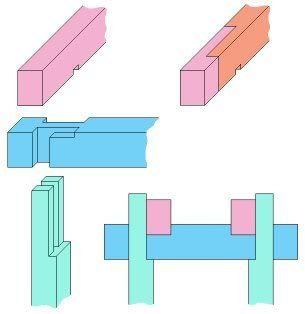
I created a few diagrams that contain all the information needed for joining the three main structural members of a grindbygg together, in a relatively simple version of grindverk that I would like to use. I did not include the diagonal braces or notches for the rafters in this picture, although these are indispensable. Dimensions on the members are not proportional, some should be larger or smaller, and in some places wooden pegs or nails are necessary to hold pieces in place. Unlike the post and tie-beam, which should never exceed the length of a single log, the rafter-holder may do so. Two variations of the rafter holder are shown, one is solid, the other is where it joins another section of timber to continue its length.
I created a few diagrams that contain all the information needed for joining the three main structural members of a grindbygg together, in a relatively simple version of grindverk that I would like to use. I did not include the diagonal braces or notches for the rafters in this picture, although these are indispensable. Dimensions on the members are not proportional, some should be larger or smaller, and in some places wooden pegs or nails are necessary to hold pieces in place. Unlike the post and tie-beam, which should never exceed the length of a single log, the rafter-holder may do so. Two variations of the rafter holder are shown, one is solid, the other is where it joins another section of timber to continue its length.
Wednesday, May 21, 2008
shed progress
I think I have all the information on building a grindbygg that I can practically get without actually traveling to Norway. The book I ordered from Norway, Grindbygningen, arrived yesterday, and I saw two books through ILL at the library. While the books answered several questions I had, they also posed new ones.
The post, tie-beam, and rafter-holder are the three most critical structural members. While the cuts are placed so as to stabilize their interlocked arrangement, too many cuts can compromise their strength. I have decided to take a middle path between the design of a primitive longhouse and the fully developed grindverk construction method when I build my shed. This photo illustrates how very few cuts are made to these three members - the post and tie-beam are obviously cut in the traditional grindverk method, but the rafter-holder has no visible cuts aside from diagonal braces (though not visible I assume they are present) and no coresponding cuts are made in the post and tie-beam to accomodate the rafter-holder. Instead of cuts used to hold the rafter-holder in place, it is wedged in place using an additional piece of wood that is fastened on the tie-beam next to the inside of the rafter-holder. Simple and effective.
Source: http://suldal.miljostatus.no/msf_themepage.aspx?m=2940
I have since (as of 5/22/08) come up with a plan that utilizes additional grindverk techniques, while allowing for strength where there are lap joints along the rafter-holder.

The post, tie-beam, and rafter-holder are the three most critical structural members. While the cuts are placed so as to stabilize their interlocked arrangement, too many cuts can compromise their strength. I have decided to take a middle path between the design of a primitive longhouse and the fully developed grindverk construction method when I build my shed. This photo illustrates how very few cuts are made to these three members - the post and tie-beam are obviously cut in the traditional grindverk method, but the rafter-holder has no visible cuts aside from diagonal braces (though not visible I assume they are present) and no coresponding cuts are made in the post and tie-beam to accomodate the rafter-holder. Instead of cuts used to hold the rafter-holder in place, it is wedged in place using an additional piece of wood that is fastened on the tie-beam next to the inside of the rafter-holder. Simple and effective.

Source: http://suldal.miljostatus.no/msf_themepage.aspx?m=2940
I have since (as of 5/22/08) come up with a plan that utilizes additional grindverk techniques, while allowing for strength where there are lap joints along the rafter-holder.
Sunday, May 11, 2008
Living water
There are a few things that a person can't live without. Fresh air, water, food, and shelter. If you've read the news lately, count yourself fortunate to have these. I like water, and not just because I drink it, or because I use it to water plants. I like water because it supports life in all its variety, because it bubbles up in springs, flows in rivers, fills the oceans, and falls from the sky. It is a beautiful, dynamic substance, and has more uses than I can list. According to Chinese philosophy, water is a symbol of yin (as in yin and yang), and it is associated with the Taoist concept of wu wei. When I was young I learned about the less obvious qualities of water - dissolved chemicals and gases, biofilms, etc. - through keeping aquariums. Changes in these often mean the difference between life and death. In my eyes, water is a living substance.
I've wanted a rainwater collection system for my house (about 1080 sq.ft. of roof area) for a long time. Last year I watched on TV the installation of several systems. This summer I met a landscaping contractor who has put in a basic system before, and offered to do the same for us. I shifted into high gear to figure out the best setup for our house. Rainwater comes into contact with a lot of things on its way to storage, and can carry things to the tank along with it, so some sort of filter is almost universally recommended. The question becomes then: which filtering method is the best?
I found a very effective and simple filter that requires cleaning only once or twice a year. It is made by the company Wisy in Germany and attested to by thousands of satisfied customers. Of the other parts to the rainwater collection system, the only electric one is the pump that pressurizes the water so you can spray it out a garden hose. If I leave for several months in the summer, the rainwater collection system will use absolutely no power and the excess stored water will simply exit out the overflow pipe (or into a second tank).
Without any vegetation around the house yet, this is the best time to excavate a hole for a 1500 gallon underground water tank and put in the collection system. I know what parts I will need for the system, I just have to find the best source for them (I have a few ideas). If it isn't too expensive then I will put it in. Next is seeding the lawn (with the free source of water to help it grow). I can then move my focus to other summer projects of varying importance.
Water has so many potential uses, it will be a very satisfying thing to know that I will always have a ready and growing supply of it on hand for any project I can imagine!
Subscribe to:
Posts (Atom)